Flushing and Strapping a Water Heater
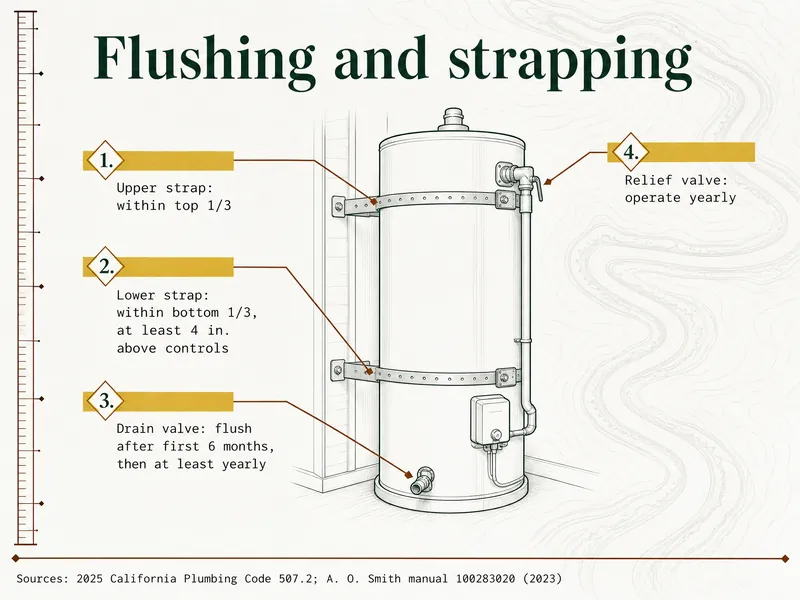
Flushing and strapping a water heater are the two yearly checks: A. O. Smith says flush after six months, then at least yearly, and California law requires two earthquake straps.
Checked against its sources by Levee Line · how figures are sourced · Last checked
Readings first
- A. O. Smith's 2023 manual says drain and flush after the first six months, then at least annually; its older manual 326940 says every 6 months.
- Health and Safety Code 19211 requires all new, replacement and existing residential water heaters to be braced, anchored or strapped against earthquakes.
- Section 507.2 of the 2025 California Plumbing Code: a strap within the top third, another within the bottom third, the lower one at least 4 inches above the controls.
- HSC 19211 covers heaters of 120 gallons or less, and home sellers must certify compliance in writing.
- The City of Sacramento's 2025 report gives 83 mg/L (4.9 gpg) system-average hardness; El Dorado Irrigation District's Main system, 13 mg/L.
- The same A. O. Smith manual says operate the relief valve yearly and inspect it every 2 to 4 years.
How often should you flush a water heater?
Follow your heater's manual; the two A. O. Smith manuals read for this page differ. The February 2023 manual for its standard gas ultra-low-NOx models says drain and flush after the first six months of operation to see how much sediment forms, then at least annually, and more often "if there is a lot of sediment". The older manual 326940 recommends draining and flushing "every 6 months".
Rheem's lifespan article says flush annually and replace the anode rod every 3 to 4 years. The six-month first flush is the useful reading: what comes out tells you whether yearly is enough for your water.
Upkeep and strapping readings
- 6 monthsFirst drain and flush, then at least yearlyA. O. Smith manual 100283020 (2023)
- 2 strapsUpper third and lower third of the tank2025 California Plumbing Code 507.2
- 4 in.Minimum gap between the lower strap and the controls2025 California Plumbing Code 507.2
- 120 galLargest heater covered by the state strapping lawHealth and Safety Code 19211
How do you flush a tank water heater?
Cool the water, shut off the heat and the cold supply, then drain through a hose. The steps below follow A. O. Smith's 2023 manual for a gas model; electric and heat pump models switch off at the breaker instead, so use your own manual.
- Turn the gas control to OFF and close the manual gas valve to the heater.
- Open a hot water faucet and let it run until the water is cool. The manual says this may take 10 minutes or longer and warns about scalding.
- Connect a garden hose to the drain valve and run it to a drain, outdoors or into buckets.
- Turn the cold water supply valve OFF, open the drain valve, and open a hot faucet to help the tank empty.
- If a lot of sediment came out, open the cold supply with the drain open and let water run until no more sediment drains.
- Close the drain valve, refill the tank with a hot faucet open to let air out, then relight following the label.
The manual adds that sediment can clog the drain valve; if the tank will not drain, it says to contact a qualified person. It also pairs the flush with an anode check, since the rod corrodes to protect the tank and is a consumable part. Do not turn the heat back on until the tank is full.
Does flushing matter on soft Sacramento water?
It matters less on river water than on groundwater, but the six-month check still tells you. A. O. Smith says the amount of sediment depends on tap hardness, temperature settings and other variables. Reports print hardness in ppm, which equals mg/L.
City of Sacramento water averaged 83 mg/L (4.9 gpg) across the system in 2025, according to its 2025 water quality report (published June 2026), and its wells ranged from 15 to 154 mg/L; USGS calls 61 to 120 mg/L moderately hard. Folsom's 2025 report gives 26.5 mg/L, and Roseville's Folsom Lake water is 26 mg/L, rising when its wells are in use. On a groundwater system such as Rio Linda/Elverta, 100% wells at an average of 99 mg/L (5.8 gpg), or Sacramento Suburban's wells at 120 to 130 mg/L, expect more in the bucket.
If you use a softener, the sediment may drop but the anode works harder. A. O. Smith's 2023 manual says the rod depletes faster with a softener and should be inspected more often. Whether a softener makes sense at all is on the do you need a water softener page, and hardness for every supplier is on the hardness by district page.
What strapping does California require for water heaters?
Two straps: the code wants one within the top third of the tank's height and the other within its bottom third. Health and Safety Code 19211 says all new and replacement water heaters, and all existing residential ones, "shall be braced, anchored, or strapped to resist falling or horizontal displacement due to earthquake motion", at minimum as the California Plumbing Code sets out.
The 2025 California Plumbing Code, section 507.2, places the straps "within the upper one-third (1/3) and lower one-third (1/3)" of the heater's height, and at the lower point keeps them at least 4 inches above the controls. The law covers standard heaters of 120 gallons or less for which a pre-engineered strapping kit is readily available.
Two related points from the statute: a seller of a home with a water heater must certify in writing that it complies, and a building in violation is deemed a nuisance. The same code section family also requires a base at least 3 inches above the ground for a heater standing on earth (507.4) and a drain pan where a leak would cause damage, such as in an attic (507.5).
How do you check water heater strapping?
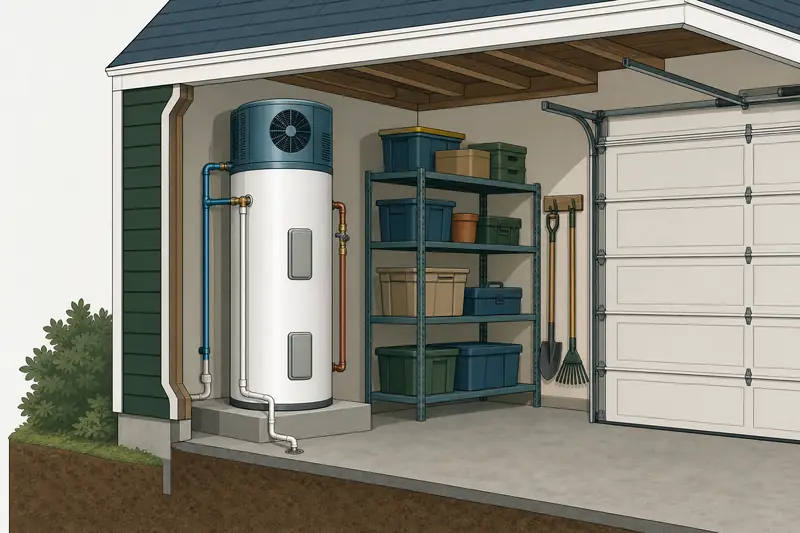
Measure the tank and look at where the straps sit. Divide the height into thirds: one strap must fall in the top third and one in the bottom third, and the lower one must clear the gas control or element cover by 4 inches or more.
- Count two straps. One strap around the middle does not meet 507.2.
- Check the anchors. Each strap should be fastened to the wall as the kit's instructions show, with no loose bolts.
- Look for a gap. A heater that can rock or slide away from the wall is not restrained.
- Check after any work. A replacement heater needs strapping under the same law, and a permitted install is inspected.
If the strapping looks wrong, a licensed plumber can correct it with a kit made for the tank's size. A. O. Smith's manual points California owners to the state's bracing instructions; the statute and code above are the binding text.
What else should a yearly check cover?
The relief valve, the anode, the pan and pressure. A. O. Smith's 2023 manual says to operate the temperature and pressure relief valve annually and inspect it every 2 to 4 years, following the label on the valve. Its older manual says to lift the lever several times and confirm the valve seats and operates freely, keeping clear of the discharge line.
Read house pressure with a gauge on a hose bib. The California Plumbing Code requires a regulator where static pressure exceeds 80 psi, and A. O. Smith suggests setting one to 50 to 60 psi; its manual also calls for a thermal expansion tank on a closed system. The water pressure and regulators page covers the test. If the heater is near the end of its life, the page on how long water heaters last sets out repair-or-replace signs.
Sounding notes
Read in October 2026 for this page: two A. O. Smith use-and-care manuals for gas heaters (100283020, dated February 2023, and the older 326940); Rheem's lifespan article; HSC 19211; plumbing code sections 507.2, 507.4, 507.5 and 608.2 in IAPMO's 2025 California edition; and 2025 reports from Sacramento, Folsom, Roseville, Rio Linda/Elverta and Sacramento Suburban. Left out: the state architect's bracing drawings (not found on a state site), strap brands, and electric or heat pump flushing steps, which vary by model.
Downstream questions
Is water heater strapping required when selling a house in Sacramento?
Yes. HSC 19211 requires the seller of any property with a water heater to certify to the buyer in writing that the heater is braced, anchored or strapped as the law requires.
Does a tankless water heater need earthquake straps?
HSC 19211 defines a water heater as a standard heater of 120 gallons or less with a pre-engineered strapping kit available. Wall-hung tankless units are mounted per the maker's instructions; ask the permit office how your jurisdiction applies the rule.
Can you flush a water heater without draining it completely?
A. O. Smith's older manual describes a flush with system pressure on: cold supply open, drain valve open, water run until it is clean. Its 2023 manual drains first, then flushes with the cold supply if sediment is heavy.
What if the drain valve will not open or keeps dripping?
A. O. Smith's 2023 manual says sediment can clog the valve and to call a qualified person if the tank will not drain. Its older manual describes replacing the drain valve washer.
How far above the controls must the lower strap be?
At least 4 inches, under section 507.2 of the 2025 California Plumbing Code. The strap must still fall within the lower third of the tank.
Does a heat pump water heater need flushing?
It is still a storage tank, so sediment and anode care apply; follow its manual. SMUD adds that heat pump models have an air filter that needs periodic cleaning.
Should the relief valve drip after you test it?
No. A. O. Smith's older manual says that if the valve does not fully reset and keeps releasing water, close the cold water inlet, drain the tank and replace the valve with a properly rated one.
Further down the channel
Back upstream: every Sacramento-region tap water reading