Sacramento Water Bill and Meters, Explained
How is a Sacramento water bill built? From two parts: a fixed monthly charge set by meter size ($35.72 for a 1-inch meter) plus $1.4587 for every CCF, or 748 gallons, the meter records.
Checked against its sources by Levee Line · how figures are sourced · Last checked
Readings first
- The City of Sacramento's rates page lists a $35.72 monthly service charge for a 1-inch meter plus $1.4587 per CCF (services and rates).
- One CCF is 100 cubic feet, or 748 gallons, so 10 CCF in a month is about 7,480 gallons.
- California Water Code 527 required urban suppliers to meter every connection by January 1, 2025; the City Auditor wrote in December 2024 that "All water customers are metered."
- The City says water and sewer rates have not changed since 2020; a five-year increase is proposed from July 1, 2027, with a public hearing in December 2026.
- EPA WaterSense's leak test: read the meter, use no water for two hours, read it again. Any change points to a leak.
- The City reimburses verified leak repairs up to $250, or up to $500 for leaks of 25 gallons an hour or more, if you apply before the repair.
The figures below are the City of Sacramento's, read in October 2026. If another supplier serves your address, its bill has the same two parts but different numbers: check which water district you are in first.
How is a Sacramento water bill worked out?
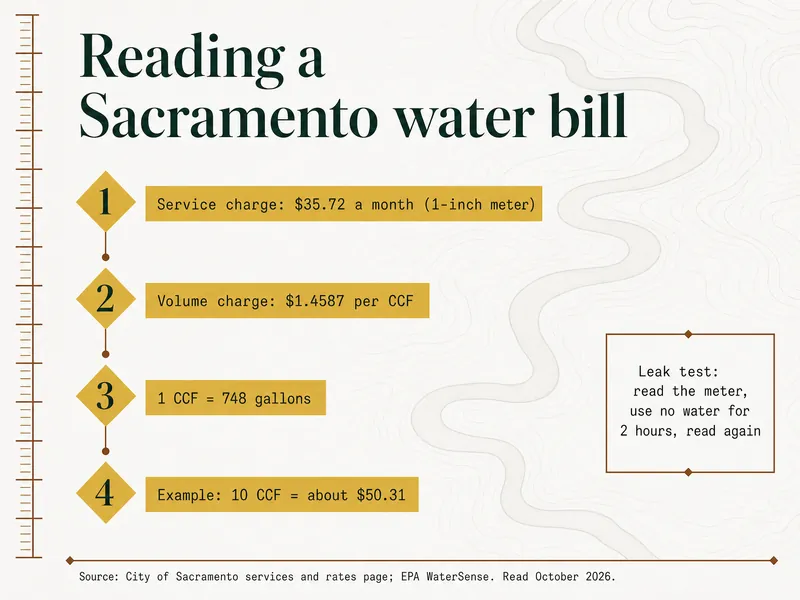
A City of Sacramento water bill is a fixed service charge plus a volume charge. The fixed part depends on the size of the meter; the City's services and rates page lists $35.72 a month for a 1-inch meter. The volume part is $1.4587 for each CCF the meter records.
A worked example: a home with a 1-inch meter that uses 10 CCF in a month pays $35.72 plus 10 × $1.4587 ($14.59), or about $50.31 for water. Sewer, stormwater and garbage are separate lines on the same City utility bill. The City's 2027 rate FAQ gives $54.47 a month as the current typical single-family water bill.
The fixed charge carries most of the revenue. The City Auditor's Water and Wastewater Fund Review (December 2024) says the monthly fixed fee "accounts for approximately 59% of rate revenues." That is why cutting use by a third rarely cuts the bill by a third.
Bill readings
- $35.72Monthly service charge on a 1-inch City meterCity of Sacramento services and rates
- $1.4587Charge per CCF of water usedCity of Sacramento services and rates
- 748Gallons in one CCF (100 cubic feet)City of Davis 2025 water quality report
- 59%Share of City water rate revenue from the fixed feeCity Auditor, December 2024
- 9,300Gallons an average household loses to leaks each yearEPA WaterSense
What is a CCF on the water bill?
A CCF is 100 cubic feet of water, which is 748 gallons. Most Sacramento-area suppliers bill in CCF (the City of Davis's 2025 water quality report spells out the same 748-gallon conversion), and the meter dial or digital display usually counts cubic feet.
To turn a bill into gallons, multiply the CCF figure by 748. A household that uses 12 CCF in a summer month has run about 8,980 gallons through the meter. To compare against a meter reading, remember the meter counts every cubic foot while the bill rounds to whole or partial CCF.
The City's older meter flyer notes that metered bills "are typically higher in the summer and lower in the winter," because outdoor watering drives most of the change. A $70 August bill and a $45 January bill can both be normal.
How do you read a water meter for leaks?
Read the meter, use no water for two hours, then read it again. EPA WaterSense says that if the reading moves at all during a two-hour period with no water in use, you probably have a leak. Turn off the irrigation controller and the ice maker first.
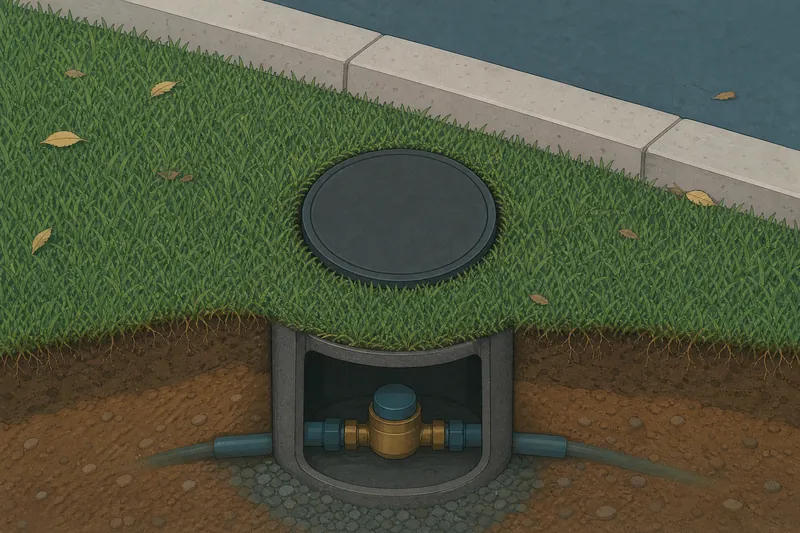
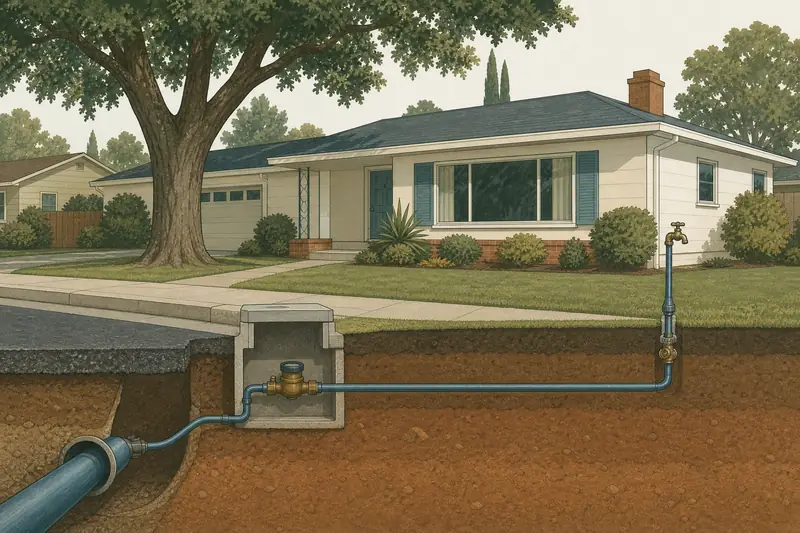
On most single-family lots the meter sits in a box near the curb or sidewalk. Lift the lid carefully, note every digit on the register, and photograph it so the second reading is easy to compare.
Toilets are the first suspect. EPA's dye test is a few drops of food coloring in the tank; if color reaches the bowl within 10 minutes, the flapper is leaking. EPA puts the average household's leaks at more than 9,300 gallons a year, which is about 12 CCF, or roughly $18 at the City's volume rate.
City customers can also track water use online by the hour, day, week or month and set email or text alerts for possible leaks. Townhome and condominium owners are the exception: many sit behind a single master meter, and the homeowners association splits the bill.
If you find a continuous leak, the City's leak repair rebate pays up to $250 for leaks under 25 gallons an hour and up to $500 for larger ones. You apply before the repair, staff verify the leak, and receipts are due within 30 days. Labor is reimbursed only for a C-36 licensed plumbing contractor, up to $150 an hour. More programs are on the water-saving rebates page.
Why did the Sacramento water bill go up?
If your water charge rose this year, the water rate was not the cause: the City's 2027 rate adjustment page says drinking water and sewer rates "have remained the same since 2020." Summer irrigation, a running toilet or a new household member will all show up in the CCF count.
Rates may change from July 1, 2027. The City mailed Proposition 218 notices in August 2026 and holds a public hearing in December 2026; a majority written protest by property owners would stop it. The City's FAQ puts the typical single-family water bill at $54.47 now, $61.39 from July 1, 2027 and $78.85 by July 1, 2031, if adopted. The City cites a $2.2 billion maintenance backlog.
The proposed structure, in the FAQ's words, "shifts more of the water bill toward the amount of water you actually use." Under that design, the leak checks above and the outdoor rebates matter more than they do now. These are proposed figures until the City Council acts.
Where can you get help paying a Sacramento water bill?
The City runs a utility rate assistance program that discounts water, sewer and garbage charges for qualifying households. According to the City's financial assistance page, you qualify if you pay the City for those services, live at the address with the bill in your name, and either meet the income limits or take part in SMUD's Energy Assistance Program Rate.
The quickest route is the SMUD one: apply online and attach a SMUD bill dated within the past two months that shows the Energy Assistance Program Rate. Otherwise you send income documents for every adult in the home. The City posts its monthly discount and income guidelines (effective January 15, 2026) on the same page; check them there rather than relying on a figure copied elsewhere.
The City's rates page adds that customers who fall behind can ask about a payment arrangement before reaching the two-months-past-due point at which water may be shut off. The financial assistance page also says City residents may qualify for a separate sewer rate assistance program run for SacSewer customers. Customers of other suppliers should ask their own district: programs and eligibility rules differ.
Do other districts bill the same way?
Yes, in outline: every urban supplier now bills by meter under Water Code 527, with a fixed charge and a volume charge. The amounts differ, and so do the tools each supplier gives you.
The City's own 2027 FAQ compares typical monthly water bills across the region: Elk Grove $101, Sacramento Suburban Water District $100, West Sacramento $76, Roseville $68 and Sacramento County Water Agency $43, against the City's proposed $61. Those are the City's comparison figures, not each district's published rate schedule.
Davis customers get hourly use and leak alerts through the AquaHawk portal, per the City of Davis's 2025 report. If you are on a private well, there is no water bill at all, but the pump's electricity and annual testing replace it: see private well testing in Sacramento County. The bills, meters and rebates hub lists the rest of this folder.
Sounding notes
This page is based on the City of Sacramento services and rates page, the 2027 Rate Adjustments page and its FAQ, the City's financial assistance, leak repair rebate and water tracking pages, the City Auditor's December 2024 Water and Wastewater Fund Review, California Water Code 527, EPA WaterSense's Fix a Leak Week page and the City of Davis 2025 water quality report, all read in October 2026. The worked examples are arithmetic on the City's published 1-inch rates; other meter sizes have other service charges. Left out: sewer and stormwater rate details, the City's dollar amounts for rate assistance (they change and are posted by the City), and any district bill figure not published by that district or the City.
Downstream questions
What happens if a Sacramento water bill goes unpaid?
The City's rates page describes a water service termination policy: customers more than two months past due may have water turned off. The same page says customers who are late or cannot pay should contact Utilities to avoid shutoff or to see whether they qualify for a payment arrangement. Rate assistance, above, is a separate discount.
Can the City estimate a bill if the meter is not read?
City meters send readings wirelessly through an automated system, so manual reads are rare. If a reading looks wrong, the City's meter flyer says a meter reader can check whether the meter is misreading or has stopped. Ask Utilities customer service through the City's website before paying a bill you think is wrong.
Does a water softener raise the water bill?
A softener uses water each time it regenerates, so it adds some CCF to the bill. How much depends on how often it regenerates, which depends on your hardness and household size. The water softener sizing page shows how to size one so it regenerates about once a week.
Is the volume rate the same in summer and winter?
Yes. The City charges a uniform rate per CCF for all consumption, according to the City Auditor's 2024 review. Summer bills are higher only because more water goes through the meter.
Who pays the water bill for a rented house in Sacramento?
The account holder pays, which can be the owner or a tenant. Rate assistance requires the bill to be in the applicant's name at the address where they live. Leak repair rebates need the owner's written permission when a tenant applies.
Do condominiums get individual City water bills?
Often not. The City says townhome and condominium service lines are usually private, with one master meter for the property, and the HOA splits the charges among units. Questions about your share go to the HOA.
Does the leak repair rebate cover a high bill caused by a leak?
No. The City says reimbursements cannot cover water loss or utility bill charges; they pay toward materials, leak detection and repair labor. One reimbursement is allowed per customer.
Further down the channel

Back upstream: Sacramento tap water, district by district