Private Well Testing in Sacramento County
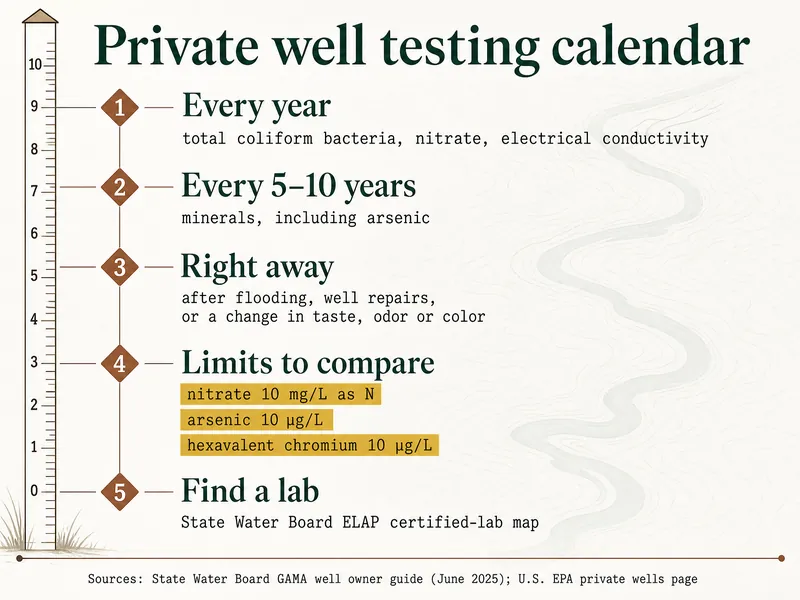
Private well testing in Sacramento County is up to the owner: California recommends testing for coliform bacteria, nitrate and electrical conductivity every year, at a lab you choose.
Checked against its sources by Levee Line · how figures are sourced · Last checked
Readings first
- Sacramento County's Environmental Management Department permits well construction, repair and destruction, but the state says it "does not regulate water quality in most private domestic wells."
- The State Water Board's GAMA program recommends testing total coliform bacteria, nitrate and electrical conductivity every year, and minerals including arsenic every 5–10 years.
- Typical lab prices in the GAMA well owner booklet (June 2025): coliform $30–70, nitrate $25–60, electrical conductivity $10–40, a mineral package $200–350.
- Compare results with drinking water limits: nitrate 10 mg/L as nitrogen, arsenic 10 µg/L, and California's hexavalent chromium limit of 10 µg/L.
- EPA says to test right away after flooding, after any well repair, or when taste, odor or color changes.
- Nearby public wells show why chromium 6 is worth a test: Rio Linda/Elverta's 12 wells averaged 10.6 µg/L in its 2025 data.
Private well numbers to know
- 95%of Californians get water from a public or municipal sourceState Water Board GAMA booklet, June 2025
- 3tests recommended every year: coliform, nitrate, electrical conductivityState Water Board GAMA booklet, June 2025
- $100–$400typical cost of basic well water analysisState Water Board GAMA testing page
- 10 mg/Lnitrate limit, measured as nitrogen (45 mg/L as nitrate)U.S. EPA drinking water regulations
Who regulates private wells in Sacramento County?
Sacramento County regulates how wells are built and closed, not what comes out of them. The county Environmental Management Department's Well Program oversees "construction, modification, repair, inactivation and destruction of wells" under Chapter 6.28 of the County Code and Section 13801 of the California Water Code, and any new well needs an EMD permit before work starts.
Water quality is the owner's job. The State Water Board's GAMA booklet for private domestic well owners (June 2025) says the state "does not regulate water quality in most private domestic wells," while counties may set their own requirements. Public systems serving 15 or more connections follow strict rules; a single-house well follows none.
The same booklet notes that about 95% of Californians get water from a public source, so well owners are a minority with no utility testing on their behalf. Domestic wells must be drilled by a contractor holding a C-57 well drilling license.
What should a private well test include?
A private well test should include, at minimum, total coliform bacteria, nitrate and electrical conductivity every year. That is the State Water Board's baseline; the U.S. EPA's private wells page adds total dissolved solids and pH to its yearly list.
Every 5–10 years, or when something changes, add a mineral package. The GAMA booklet's package covers aluminum, arsenic, barium, cadmium, chromium, fluoride, iron, lead, manganese, mercury, selenium and silver. In the Sacramento Valley, ask the lab to include hexavalent chromium as well: California's limit of 10 µg/L took effect October 1, 2024, and nearby public wells test close to it.
Add volatile organic compounds if a gas station, dry cleaner or industrial site is nearby. The City of Sacramento's 2025 report lists those as vulnerabilities for its own wells north of the American River.
How often should you test a well?
Test every year for bacteria, nitrate and conductivity, and every 5–10 years for minerals. The GAMA booklet's reasoning is that groundwater quality "can change over time" as pumping and recharge shift what the aquifer delivers, so a clean result five years ago does not cover today.
Keep each lab report. Electrical conductivity is a cheap yearly check precisely because a jump from your last result signals that something changed; the booklet says to follow a high or changed reading with tests for minerals, nitrate or volatile organics.
Inspect the wellhead each year too. The booklet asks owners to check the cap, seal and concrete pad for damage, because a cracked seal lets surface water in. Repairs belong with a state-licensed well driller.
How do you find a certified lab?
Use the State Water Board's Environmental Laboratory Accreditation Program (ELAP) map, linked from the GAMA testing page and the ELAP home page. It shows accredited labs by location. The state says an ELAP lab is not always necessary for a private well, but it recommends one for reliable results.
Call the lab before sampling. Most supply sterile bottles and instructions, and the State Water Board suggests getting a written estimate first, since basic analysis typically costs $100–400. Home test kits can show whether something is present, but only a lab gives a concentration you can compare with a limit.
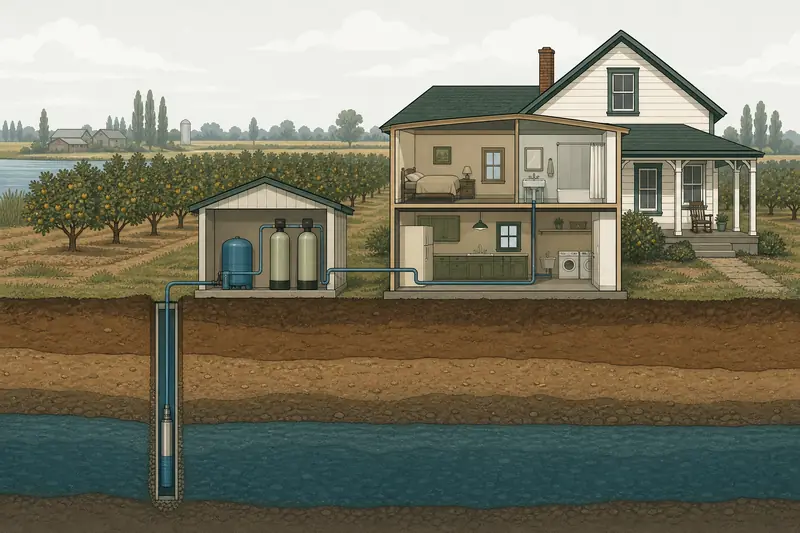
Take the sample as close to the wellhead as you can, before any softener, filter or pressure tank treatment, so the result reflects the groundwater itself. If you also want to know what reaches the kitchen, take a second sample there.
What do the results mean?
Results mean the most when compared with drinking water limits: the GAMA testing page recommends observing the same MCLs that public systems must meet. Nitrate above 10 mg/L as nitrogen, arsenic above 10 µg/L or hexavalent chromium above 10 µg/L each calls for a retest and, if confirmed, another drinking water source while you work out a fix.
Coliform bacteria "present" means retest, find the cause, disinfect the well and test again. The booklet warns that boiling does not remove many chemical contaminants, so it is no answer to nitrate or arsenic. Hardness is different: it leaves spots and scale but, the booklet says, "can still be safely consumed."
Nearby public wells give a sense of what Sacramento-area groundwater carries. These are source results from public supply wells, not private wells, but they show which rows to watch.
Sources for that table: the City's 2025 report, Sacramento Suburban WD's 2025 report, Rio Linda/Elverta's 2026 report and SCWA's 2025 Central/South report. Treatment options for each result are on the well water treatment page.
When should you test right away?
Test right away after flooding near the well, after any repair or part replacement, or when the water's taste, odor or color changes. That list comes from the U.S. EPA's private wells page, which also adds nearby land disturbance or new construction and known groundwater problems in the area.
After a flood, EPA's steps are to stay away from the pump while it is flooded, not to drink or wash with the water, and to have a well or pump contractor clean and disinfect the well before turning the pump back on. Then pump until the water runs clear and test before drinking.
Between tests, keep the wellhead cap sealed and the concrete pad sloping away from the casing, as the GAMA booklet advises. For hard water and softeners on a well, see do you need a water softener; for chromium specifically, see chromium 6 and PFAS.
Sounding notes
This page is built on the State Water Board GAMA program's booklet for private domestic well owners (June 2025) and its domestic well testing page, the ELAP program page, Sacramento County EMD's Well Program page, the U.S. EPA's private wells and drinking water regulation pages, the State Water Board's chromium 6 page, and well results printed in four 2025 supplier reports (City of Sacramento, Sacramento Suburban WD, Rio Linda/Elverta CWD, SCWA), all read in October 2026. Left out: EMD fees and setback distances (not read from the county's own pages), lab names and prices from individual labs, and treatment product claims.
Downstream questions
Does Sacramento County test private wells for free?
Levee Line found no free county testing program on the EMD Well Program page. The county permits and inspects well construction; testing is arranged by the owner with a lab.
Do you need a permit to repair a private well?
Yes for most work. EMD's Well Program covers construction, modification, repair, inactivation and destruction, and the GAMA booklet says drillers must get the local permit before any of those jobs.
Is a home test kit good enough?
For a quick screen, perhaps, but the State Water Board notes that kits show whether something is present, not how much. Only a lab result can be compared with a limit such as 10 mg/L for nitrate.
What should you do if coliform bacteria show up?
Retest to confirm, then find the cause, disinfect the well and test again, per the GAMA booklet. Until a clean result comes back, bottled or other safe water for drinking is the cautious choice.
Does a water softener make well water safe?
No. A softener handles hardness, and sometimes iron, but not bacteria, nitrate, arsenic or chromium 6. Test first, then match any treatment to the result.
What happens to an old well you no longer use?
It should be properly destroyed under a county permit by a licensed driller. The GAMA booklet warns that unused wells can let contamination reach the aquifer.
Further down the channel
Back upstream: every Sacramento-region tap water reading