Backflow Testing in Sacramento: Who Needs It
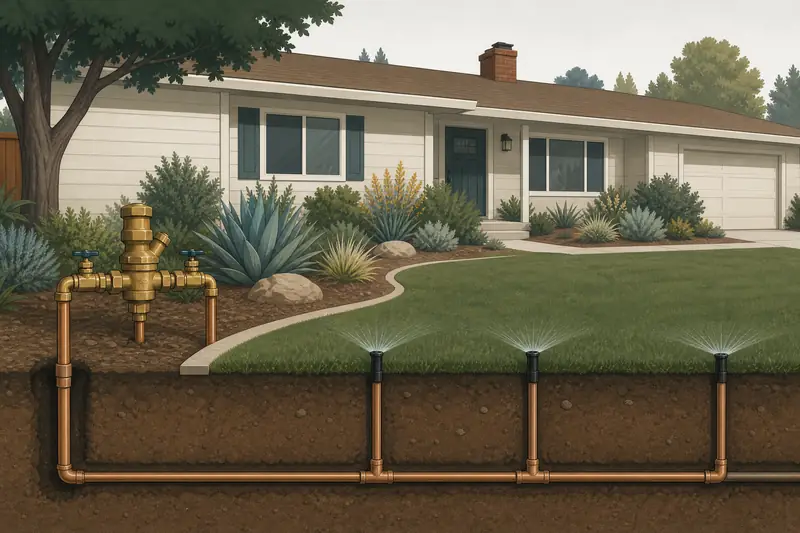
Backflow testing in Sacramento applies to homes that have a backflow assembly, usually on a dedicated irrigation line, fire sprinkler line or a well hookup, and California requires a certified tester to check it at least once a year.
Checked against its sources by Levee Line · how figures are sourced · Last checked
Readings first
- The State Water Board's Cross-Connection Control Policy Handbook took effect July 1, 2024, replacing the old Title 17 rules, and a revised version was adopted April 21, 2026 (State Water Board).
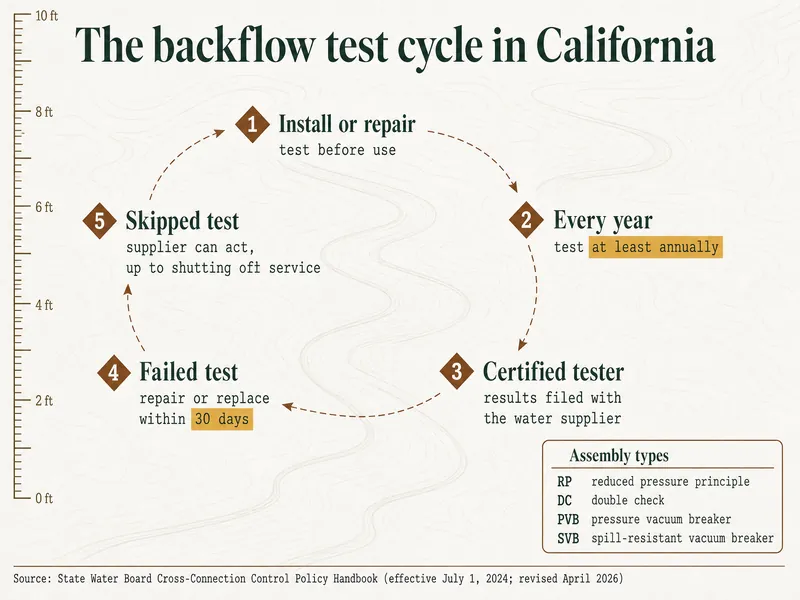
- Backflow assemblies "must be field tested at least annually" and after installation, repair, winterizing or relocation, by certified testers.
- An assembly that fails its test must be repaired or replaced within 30 days of notice, unless the supplier's plan allows more time.
- The City of Sacramento says "All dedicated Irrigation Services require the installation of a Backflow Prevention Assembly" (Section 13 design standard).
- Sacramento County's Environmental Management Department sends yearly test letters for external assemblies and posts a certified tester list (updated September 1, 2026).
- Under Health and Safety Code 116820, violating the state's cross-connection article is a misdemeanor punishable by up to $500, up to 30 days, or both.
Backflow readings
- 1 a yearMinimum test frequency for each backflow assemblyState Water Board handbook
- 30 daysTime to repair or replace an assembly that failsState Water Board handbook
- July 1, 2024Date the handbook replaced the Title 17 rulesState Water Board
- $500Maximum fine for violating the cross-connection articleHealth and Safety Code 116820
Which Sacramento homes need backflow testing?
A Sacramento home needs backflow testing only if it has a backflow prevention assembly that the water supplier requires. Most single-family homes on one domestic meter have none. The common exceptions are homes with a separate irrigation service, some homes with fire sprinklers, and homes with a private well or other water source on the same property.
The City of Sacramento's Section 13 design standard says dedicated irrigation services require an assembly and must be metered. Sacramento County's Environmental Management Department tracks external assemblies "for fire systems, irrigation applications and commercial buildings" and says any required external device "is required to be tested annually".
The State Water Board's handbook lists "Sites with an auxiliary water supply", such as a well also tied to the house plumbing, among high-hazard premises that need an air gap or a reduced pressure assembly. A home that uses recycled water for landscape irrigation in an approved dual-plumbed area needs at least a double check. If you get a yearly test letter, your supplier already has an assembly on file for your address. Not sure which supplier sends it? See which water district you are in.
What is backflow?
Backflow is water running the wrong way, from a home's piping back into the public main. The handbook names two causes: backsiphonage, when pressure in the main drops below atmospheric, and backpressure, when a private system pushes harder than the main. It lists "main breaks, flushing, pump failure, or emergency firefighting water demand" as causes of backsiphonage.
A cross-connection is any point where drinking water could meet something else: a sprinkler line sitting in fertilized soil, a hose dropped in a pool, a well pump tied into the house. The City of Sacramento's cross-connection page says backflow can happen "when a customer's system pushes liquid back into the main or when a drop in pressure pulls water the wrong way".
Which backflow assemblies do homes use?
Homes use four testable assembly types, and the handbook defines each by what it can stop. Reduced pressure principle (RP) and double check (DC) assemblies stop both backsiphonage and backpressure; pressure vacuum breakers (PVB) and spill-resistant vacuum breakers (SVB) stop backsiphonage only. All four carry test cocks and shutoff valves so a tester can check them in place.
Your supplier decides which type is required at your connection after a hazard assessment. For approved models, Sacramento County points to the University of Southern California Foundation for Cross-Connection Control and Hydraulic Research for that list.
How often does California require backflow testing?
California requires each backflow assembly to be tested at least once a year. Section 3.3.3 of the handbook says assemblies "must be field tested at least annually" and also after "installation, repair, depressurization for winterizing, or permanent relocation". Suppliers or health agencies may require more frequent tests for high-hazard sites or assemblies at higher risk of failing.
The City of Sacramento says the same in plain words: "State regulations require property owners to have their backflow prevention assemblies tested annually by a certified tester." A homeowner who shuts off and drains an irrigation assembly for winter should plan on a retest when it goes back into service. A new assembly must pass a test before the supplier provides continuous service through it.
Who can do a backflow test?
Only a certified backflow prevention assembly tester can do the test that counts. The handbook requires certification from an organization the State Water Board recognizes, with a timed, proctored, closed-book exam of at least 100 questions for initial certification and 50 for renewal. Testers must also verify their own test gauges at least once a year.
In the City of Sacramento, testers file results through the Sacramento Backflow Tester Portal, and the City links a list of certified testers on its cross-connection page. Sacramento County EMD keeps its own certified tester list, updated September 1, 2026, and an online portal for results. Other suppliers run their own programs: check the letter you receive for where results go.
What happens if you skip backflow testing?
If a required test is skipped, the supplier can step in, and that can mean shutting off water service. The handbook requires every supplier to have legal authority to do at least one of three things when a customer fails to comply: "deny or discontinue water service", test or maintain the assembly itself, or otherwise address the failure promptly.
State law backs that up. Health and Safety Code 116800 says water users "shall comply with all orders, instructions, regulations, and notices" about backflow devices, and 116820 makes a violation a misdemeanor with a fine of up to $500, up to 30 days in jail, or both. Sacramento County EMD's program starts with an annual notification letter; the date on it is the one to meet.
A failed test is different from a skipped one. The supplier must see the assembly repaired or replaced within 30 days of the failure notice. A backflow assembly also costs some pressure on its line, as the City of Davis notes on its water FAQ; the water pressure page covers how to read it, and the Lines and pipes hub gathers the other street-to-house topics. Irrigation rebates that may involve these lines are on water-saving rebates.

Sounding notes
Based on the State Water Board's Cross-Connection Control Policy Handbook (effective July 1, 2024; revised April 21, 2026) and its program page; Health and Safety Code 116800 to 116820; the City of Sacramento's cross-connection control page and Section 13 design standard (rev. July 24, 2018); Sacramento County EMD's cross-connection program page; and the City of Davis water FAQ, all read October 2026. Left out: test fees, which vary by tester and supplier; any ranking of testers; and supplier-specific rules not published on the pages above.
Downstream questions
Does a typical Sacramento house with one water meter need a backflow test?
Usually not. Testing applies to homes where the supplier requires an assembly, most often on a dedicated irrigation service, a fire sprinkler line or a property with a well. A yearly letter from your supplier or Sacramento County is the sign that one is on file.
Who sends the backflow test reminder in Sacramento County?
It depends on the supplier. The City of Sacramento runs its own program and tester portal, while Sacramento County EMD sends annual notification letters for external assemblies it tracks. Other suppliers run their own programs.
Can a homeowner test their own backflow preventer?
Only if they hold a tester certification from a State Water Board-recognized organization. The handbook requires certified testers for every required field test. A homeowner can still look for leaks or damage between tests.
Do fire sprinklers in a new house need a backflow assembly?
Not always. The handbook lets a low-hazard residential fire system skip the assembly if the home has one service connection, one combined meter, NSF/ANSI 61 piping and a looped system tied to a regularly used fixture. Otherwise at least a double check is required.
Is a hose bib vacuum breaker the same as a backflow assembly?
No. A small screw-on hose bib vacuum breaker has no test cocks and is not one of the four testable assemblies in the handbook. It is a plumbing fitting, not something the supplier's annual test program covers.
What if my backflow assembly fails its test?
It must be repaired or replaced within 30 days of the failure notice, unless your supplier's cross-connection plan allows an extension. A passing retest by a certified tester closes it out.
Does winterizing an irrigation backflow assembly require a new test?
Yes. The handbook requires a field test after depressurization for winterizing, so a drained assembly needs a test when it goes back into service.
Further down the channel

Back upstream: Sacramento tap water, supplier by supplier