Chlorine Taste in Sacramento Water
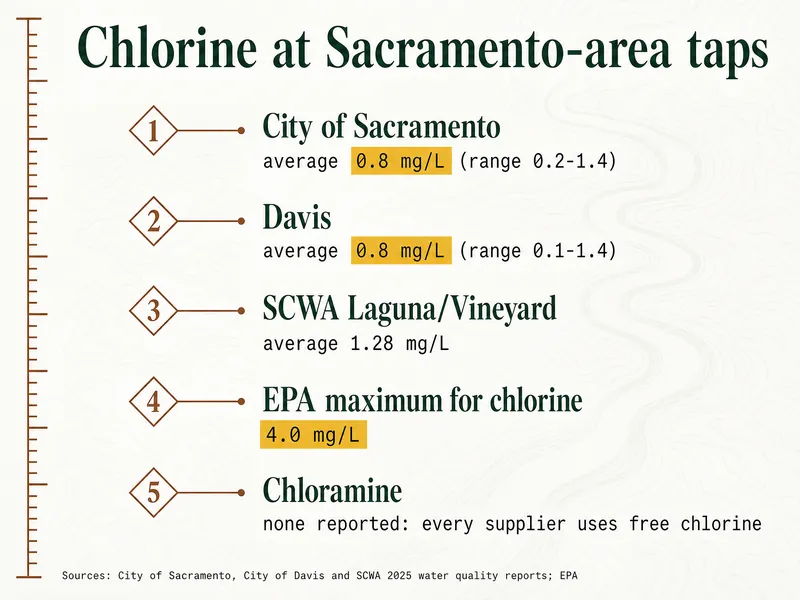
Chlorine taste in Sacramento water comes from the free chlorine left in to keep pipes clean: the City of Sacramento's 2025 report averages 0.8 mg/L, a fifth of EPA's 4.0 mg/L ceiling.
Checked against its sources by Levee Line · how figures are sourced · Last checked
Ownership note: Levee Line shares its owners with SoftPro Water Systems and Quality Water Treatment, the two stores this page links to. Figures on this page come from Sacramento-area suppliers' own 2025 water quality reports, California and federal rules and certifiers' listings, read in October 2026. Anything a store says about its own product is reported as the store's claim. How store links work here
Readings first
- The City of Sacramento's 2025 water quality report lists chlorine at an average of 0.8 mg/L in its pipes, with a range of 0.2 to 1.4.
- EPA caps chlorine in delivered water at a maximum residual disinfectant level of 4.0 mg/L (National Primary Drinking Water Regulations).
- Every Sacramento-region report read for this site names free chlorine; none reports chloramine, and the Woodland-Davis plant answers the question directly: "No."
- EPA WaterSense points buyers to NSF/ANSI 42, the standard for taste and odor, when choosing a filter for chlorine.
- A pitcher of tap water left open in the refrigerator for a day or two loses most of its chlorine smell, per the same EPA publication.
- A carbon filter does not remove nitrate, bacteria or dissolved minerals, so it changes taste, not hardness.
Why does Sacramento water taste of chlorine?
Because suppliers keep a small dose of chlorine in the water all the way to your tap, so bacteria cannot regrow in the mains. The City of Sacramento's 2025 report puts the distribution average at 0.8 mg/L; reports print this as ppm, which is the same thing (they also use ppb and ppt for smaller amounts).
The dose you taste moves within that 0.2 to 1.4 range from day to day and street to street. Neighboring suppliers sit in the same band, as the table shows, with Sacramento County Water Agency's Laguna/Vineyard area the highest average at 1.28 mg/L in its 2025 Central/South report. Davis averages 0.8 mg/L in its 2025 water quality report, and Golden State Water's Cordova report 1.0 mg/L.
Not every odd taste is chlorine. Late-summer complaints of a damp-soil flavor trace to geosmin and 2-MIB, which the City's report says conventional treatment does not remove; its advice is to chill the water. If the smell is swimming-pool sharp, it is chlorine; if it is like damp soil, it is the river.
Does any Sacramento supplier use chloramine?
No. Each 2025 report this site read, from the City of Sacramento and San Juan Water District to Roseville, Folsom, Sacramento Suburban, Carmichael, Golden State's Cordova system and the county water agency, reports free chlorine as the disinfectant. The Woodland-Davis Clean Water Agency's treatment page asks "Are there chloramines in my drinking water?" and answers "No."
That matters when shopping. Chloramine is a chlorine-ammonia compound some utilities elsewhere use, and filter listings often claim both; on Sacramento-area water the chlorine claim is the one that applies. If you move or your supplier changes treatment, the disinfectant row of the annual report will say so; how to read a water quality report shows where to look.
Chlorine readings and rules
- 0.8 mg/LCity of Sacramento chlorine average in its pipes, 2025City of Sacramento 2025 CCR
- 4.0 mg/LEPA maximum residual disinfectant level for chlorineU.S. EPA
- 1.28 mg/LSCWA Laguna/Vineyard chlorine average, 2025Sacramento County Water Agency
- 0Sacramento-region suppliers reporting chloramine in 2025Supplier 2025 reports
Should you filter chlorine taste at one tap or the whole house?
For taste alone, one tap is usually enough: you drink and cook from the kitchen, not the laundry. EPA WaterSense's November 2024 publication on selecting water treatment systems says point-of-use devices are "best suited" for drinking and cooking water and that many household uses "do not require additional water treatment".
The costs differ by an order of magnitude. EPA puts basic pitchers and tap filters under $100, while point-of-entry (whole-house) systems "can cost thousands of dollars" and generally need professional installation. A whole-house carbon filter makes sense mainly if chlorine smell in the shower bothers you, or you want every tap the same. Whichever you choose, look for NSF/ANSI 42 certification for chlorine taste and odor and check the claim in the certifier's online listing.
There is also a free option. The same EPA publication says chlorine "will naturally evaporate" from an open pitcher kept in the refrigerator for a day or two. On 0.8 mg/L water, that is often all the treatment a household needs.
What does a whole-house carbon filter do?
It runs all incoming water through a tank of activated carbon, which adsorbs chlorine before the water reaches any tap. EPA's comparison table says carbon filters improve taste and odor and remove some organic chemicals, including some chlorination byproducts, solvents and pesticides.
Both stores linked from this site sell an upflow catalytic carbon unit for city water. SoftPro lists its Chlorine+ Carbon Whole House Filter (sold by SoftPro Water Systems, which shares Levee Line's owners) at $1,097, and Quality Water Treatment lists the SoftPro Whole House Chlorine+ Filter (sold by Quality Water Treatment, which shares Levee Line's owners) at $917–$1,097 (each store's listed price in October 2026). The stores describe them for chlorine and chloramine; on Sacramento water, the chlorine part is the one that applies. No contaminant-reduction certification was found for either listing: the marks shown on the Quality Water Treatment page, NSF/ANSI 61 and 372, cover materials and parts, not what the filter removes.
Plumbing a tank in is usually a job for a licensed plumber, with a bypass valve so the filter can be serviced and a local permit where one is required.
What does a carbon filter not do?
It does not soften water, kill bacteria or remove nitrate. EPA's table says filtration "does not remove nitrates, bacteria, or dissolved minerals", so calcium and magnesium pass straight through and hardness is unchanged. If scale is the problem, see do you need a water softener.
It is also not a lead or PFAS device unless a certifier lists it for those claims. Lead certification runs under NSF/ANSI 53 or 58, covered on lead in Sacramento tap water; for drinking-water contaminants beyond taste, a certified reverse osmosis unit at one tap is the usual route, compared on reverse osmosis in Sacramento.
One more trade-off: once chlorine is gone, the water in your house pipes no longer carries the supplier's disinfectant. That is why point-of-use filtering at the kitchen, rather than at the meter, is the conservative choice.
How do you keep a carbon filter working?
Replace or service it on the maker's schedule, not when the taste comes back. EPA WaterSense says filters "should be replaced according to the manufacturer's instructions" and warns that "unmaintained systems may make water quality worse."
For a pitcher or under-sink cartridge, that means a gallon or month count printed on the cartridge. For a whole-house tank, read the listing's media life and the valve's backwash setting, and note the install date on the tank. A quick test is simple: a pool-style chlorine strip at a filtered tap should read near zero, while an unfiltered hose bib reads close to your supplier's average.
Sounding notes
Sources behind this page: 2025 annual reports from the City of Sacramento, City of Davis, Golden State Water (Cordova), Sacramento County Water Agency, San Juan Water District and Sacramento Suburban Water District; the Woodland-Davis Clean Water Agency treatment page; EPA's National Primary Drinking Water Regulations table; and EPA WaterSense's November 2024 publication on selecting water treatment systems. All were read in October 2026. Store prices and descriptions are the listings as of October 2026; certification status comes from searches of the NSF, WQA and IAPMO listings. Left out: removal percentages and health claims from store listings, which no certifier backs.
Downstream questions
Is 0.8 mg/L of chlorine safe to drink?
It is below EPA's maximum residual disinfectant level of 4.0 mg/L, the federal ceiling for chlorine in delivered water. Suppliers keep a residual on purpose so bacteria cannot regrow in the pipes.
Why does my tap smell stronger some weeks?
Residuals move within each supplier's range: the City of Sacramento reports 0.2 to 1.4 mg/L in its 2025 report. A day at the high end of that range tastes noticeably stronger than one at the low end.
Does boiling remove chlorine taste?
Chlorine is volatile, so heating or standing time reduces it. EPA's suggestion is simpler: leave an open pitcher in the refrigerator for a day or two.
Does a refrigerator filter handle chlorine?
Many do; check that the replacement cartridge is certified to NSF/ANSI 42 for chlorine taste and odor, and change it on the maker's schedule.
Will a whole-house carbon filter help dry skin?
This site makes no skin or health claims for any filter. What a carbon filter does is reduce chlorine taste and smell; anything beyond that needs a certifier's listing.
Does West Sacramento use chlorine too?
Yes. Its 2024 report, the latest posted, describes chlorination before and after filtering, though it prints no residual figure.
Does a carbon filter change the City's fluoride?
Activated carbon for chlorine is not a fluoride treatment; the City of Sacramento adds fluoride to an average of 0.7 mg/L, per its 2025 report. Check a certifier's listing before believing any fluoride claim.
Further down the channel

Back upstream: Sacramento tap water, district by district